Live IBAT DTX On Stage Demo in San Antonio
Over 700 bankers at the IBAT Annual Convention watched live settlement on the DTX Network, powered by Rimark's Solstice Protocol, and checked each transaction on their phones.
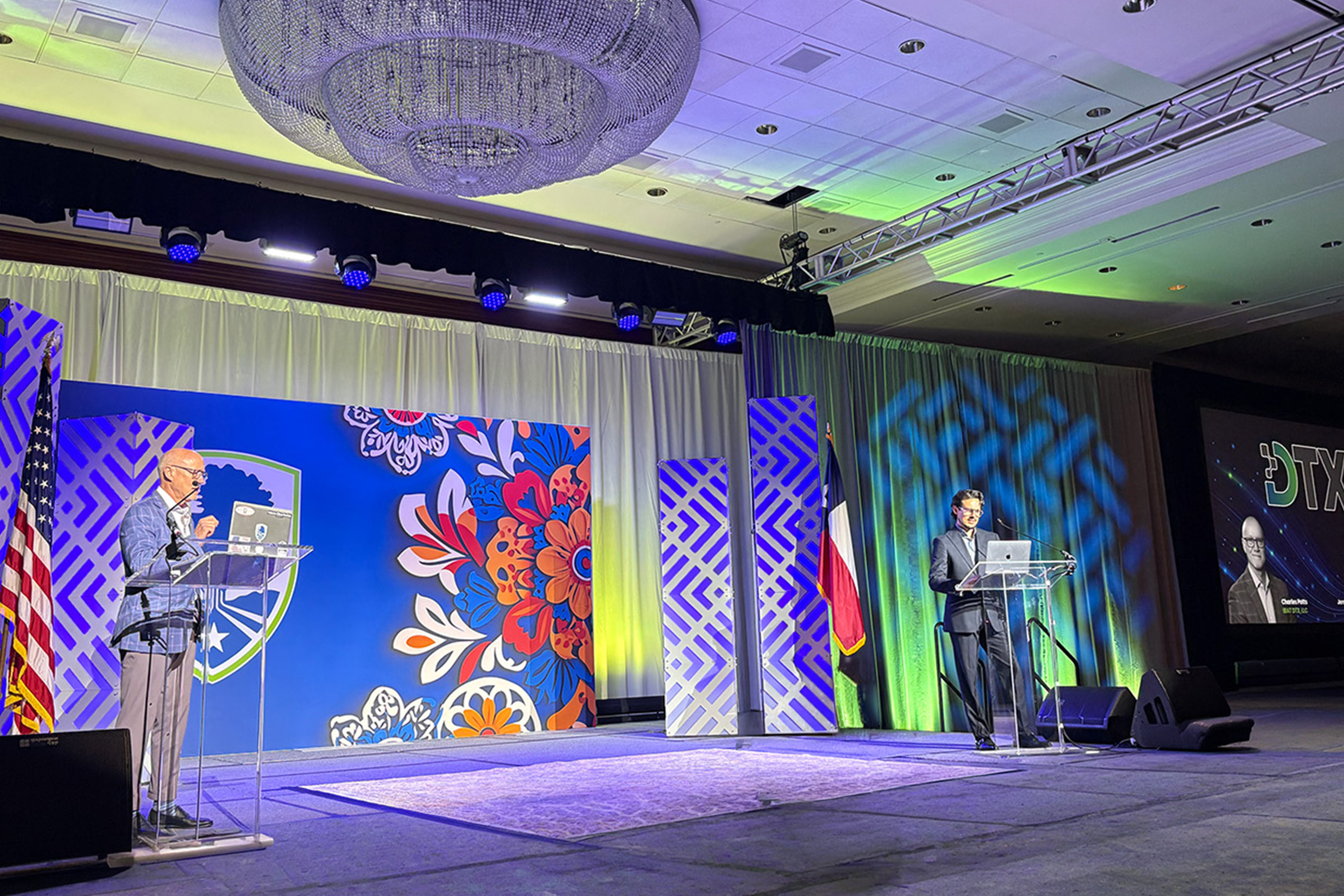
Over 700 bankers at the IBAT Annual Convention watched live settlement on the DTX Network, powered by Rimark's Solstice Protocol, and checked each transaction on their phones.
SAN FRANCISCO – September 30, 2026 – Rimark Technology Inc. (Rimark), the settlement layer technology partner to DTX, LLC (DTX), today announced continued progress on the DTX Network following a live sandbox demonstration at the 2026 IBAT Annual Convention on September 20. DTX is the community bank consortium formed by the Independent Bankers Association of Texas (IBAT) to develop and deploy digital asset technology for the good of community banks, and it governs the DTX Network, the settlement network its member banks transact on. Rimark builds and operates that network on its Solstice Protocol, which runs on a Solana Permissioned Environment (SPE).
On stage, Charles E. Potts, President of DTX, and Jeremy Vaughn, Founder and CEO of Rimark, walked the room through three live transactions using two simulated community bank views. In the first, one bank sent bank-issued tokenized deposit value to another, and the transfer settled instantly. In the second, verified business rules calculated a participant bank's share of a participation-loan payment and paid it out once approved under the bank's controls. The third showed programmable reversibility, returning a payment under conditions the participating banks set in advance. Attendees scanned a QR code and followed each transaction on a block explorer as it settled. Together, the scenarios showed how a bank-governed network improves transaction visibility, coordination, auditability and reconciliation across participating institutions.
A tokenized deposit is a bank deposit in digital form: the same liability of the same bank, owned by the same customer, able to move and settle on a shared network in seconds. For community banks, that is the difference from a stablecoin. When a customer moves money into a stablecoin, it leaves the bank and becomes a claim on a separate issuer's reserves. A tokenized deposit stays on the issuing bank's balance sheet, where it keeps funding loans in the bank's own community. It remains a deposit, with the regulatory treatment that comes with one, and the customer relationship stays with the bank.
The Solstice Protocol runs the DTX Network on a Solana Permissioned Environment: Solana's execution engine operating as an independent network, with its own validators and its own ledger, and no dependency on Solana's public chain or token. Membership is limited to regulated institutions the members admit. Each bank connects to the network through its own issuer RPC node and issues its own tokenized deposits, which stay on its balance sheet. Interbank transfers settle atomically, so both legs complete together, and compliance rules run inside the transfer. The ledger records a cryptographic commitment to each payment's details, while the details stay with the banks.
“Over 700 bankers watched a tokenized deposit settle between two banks, then pulled out their phones and checked it on the block explorer themselves,” said Jeremy Vaughn, Founder and CEO of Rimark. “Community banks now have settlement technology the largest banks have kept in-house, on a network their own consortium governs. From here, together with DTX, we take the DTX Network off the convention stage and into the pilot banks.”
“The convention demonstration marked an important step from vision to visible progress,” said Charles E. Potts, President of DTX. “Our banks and technology partners showed what can happen when community banks do more than prepare for change - they help lead it. We are building practical, governed infrastructure that keeps banks at the center of deposit ownership, customer relationships and decision-making. We leave the convention with real momentum, a clear path forward and confidence in what this consortium can deliver together.”
DTX's member banks decide how the DTX Network is developed, governed and deployed, and each participating bank keeps responsibility for its own customers, deposit liabilities, approvals, compliance obligations, and books and records. More than 30 community banks across multiple states supported DTX's first round of pilot-phase funding.
Following the convention, DTX and Rimark will continue advancing the pilot, refining the operating and governance framework, and working with participating banks to validate priority use cases and implementation requirements.
For more about DTX, visit ibat.org.
About Rimark
Rimark Technology Inc. builds the settlement network for tokenized finance: bank-issued, AI-verifiable, and settling inside the regulated banking system. Its Solstice Protocol makes insured bank deposits programmable, so software can move them, check them and, under rules the banks set, pull them back. Solstice runs on a Solana Permissioned Environment (SPE) as a public permissioned settlement network: membership is permissioned to regulated institutions, and what can be built on it is public. Deposits stay on each issuing bank's balance sheet, and transfers between banks settle atomically. Solstice debuted at Solana Breakpoint in Amsterdam in 2023, two years before Congress passed stablecoin legislation. Rimark is based in San Francisco.
About DTX
DTX, LLC is a community bank-focused consortium formed by the Independent Bankers Association of Texas to develop and deploy digital asset technology for the good of community banks. Supported by more than 30 community banks across multiple states, DTX is advancing a collaborative, bank-governed approach to tokenized deposits and digital banking infrastructure. The consortium's work is intended to help community banks remain central to deposit ownership, customer relationships and the future of payments while supporting responsible innovation, interoperability and regulatory alignment.
About IBAT
Formed in 1974, the Independent Bankers Association of Texas represents Texas community banks. The Austin-based group is the largest state community banking organization in the nation, with membership comprising more than 2,500 banks and branches in more than 700 Texas communities. IBAT member banks are committed to providing safe and responsible financial services and supporting and investing in their local communities.