Project Agora Built the Central Banks' Unified Ledger. No Agents Invited.
The most credible proof yet that tokenized money works came from seven central banks. Read what it did — and what it left untouched.
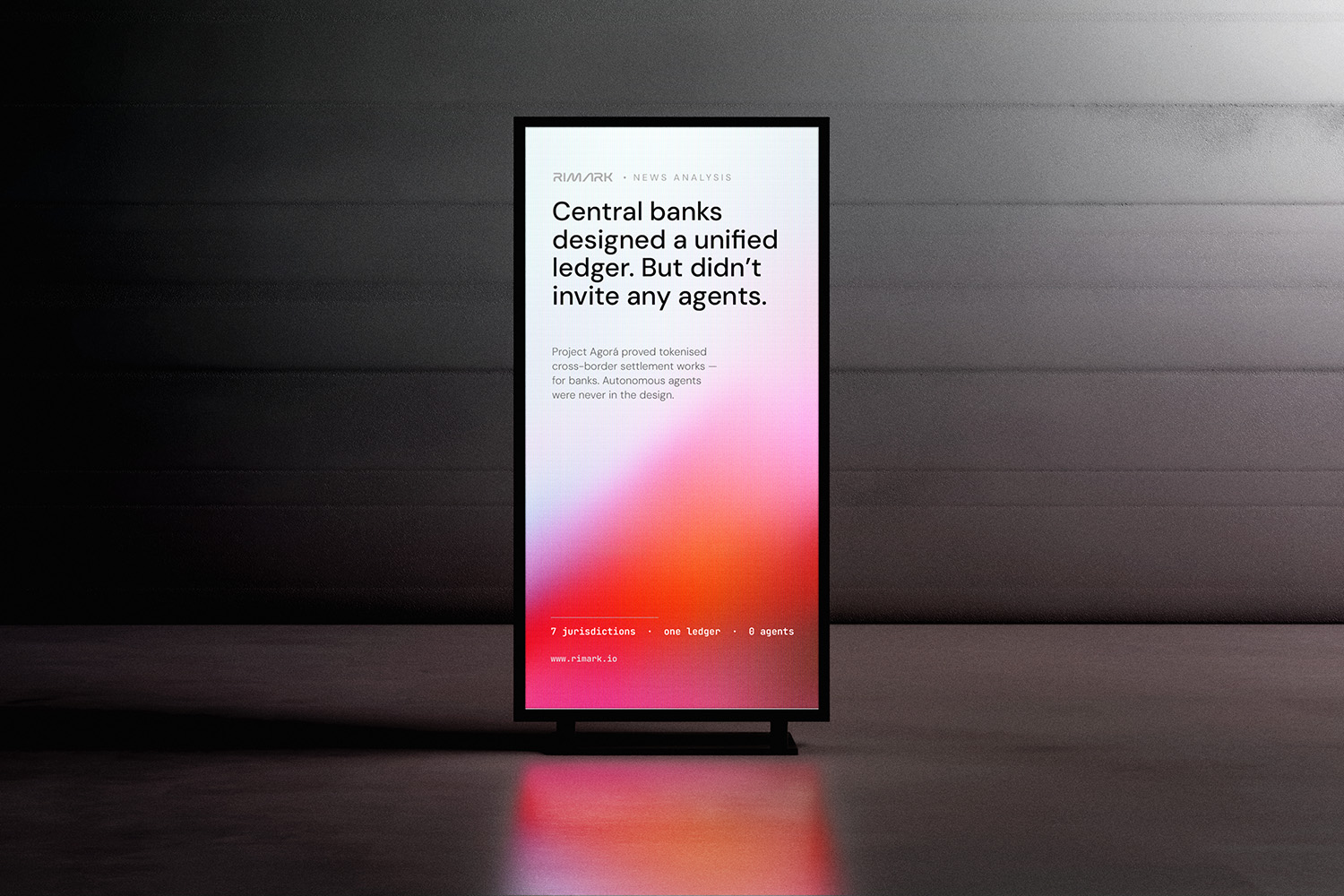
In May 2026, the Bank for International Settlements and a group of central banks published the results of Project Agora — a prototype showing that tokenized commercial-bank deposits and tokenized central-bank money can settle together, atomically, across currencies and borders, on a shared programmable platform. Seven central banks, dozens of private financial institutions, one shared ledger. It is the most credible public demonstration to date that this whole model — regulated money, tokenized, settling on programmable infrastructure — works.
If you needed proof that tokenized bank money isn't a crypto fantasy, Agora is it. When the central banks of major economies build a unified ledger for tokenized deposits and central-bank reserves and conclude that atomic cross-border settlement works on it, the premise is settled at the highest level of the financial system. Anyone still arguing that regulated money doesn't belong on programmable rails is now arguing against the central banks.
So take the validation fully. And then look precisely at what Agora is, because the boundary is as instructive as the achievement.
Agora is a wholesale, institution-to-institution system. Its participants are central banks and large financial institutions. Its purpose is cross-border settlement between those institutions — making the correspondent-banking system faster and cheaper by putting it on a unified ledger. Its programmability, in the project's own framing, is about conditional and always-on payments between institutions. Search the materials and you won't find AI agents, machine-initiated settlement, or autonomous software as a participant. That's not an oversight. It's the scope. Agora is solving how institutions settle with each other. It is not solving how software holds and spends money.
Those are different problems, and Agora sits at the top of one of them. It's arguably the ceiling of the institutions-settling-with-institutions model — the most advanced version of banks and central banks moving tokenized money among themselves. That model is enormously valuable, and it's most of what the tokenized-money conversation has been about. But it stops exactly where the agent economy begins.
Here's the distinction that matters. Agora makes settlement between institutions programmable — a bank can attach conditions to a transfer to another bank, and the money can settle when they're met. Agentic money makes money usable by non-institutions — by autonomous agents that hold balances, verify counterparties, and settle on their own authority. Agora's “programmable” is institutions configuring transfers between themselves. Agentic money's “programmable” is software being a party to the transaction. One is a better pipe between banks. The other is money a machine can hold. They're complementary, and they're not the same layer.
This reframes where Agora fits in the agentic-money story. It's not a competitor and it's not the thing agents need — it's the foundation being laid at the institutional level, which makes the layer above it more valuable, not less. The more the central banks and large institutions build unified ledgers for tokenized money, the more real, settled, tokenized value exists in the system — and the more useful it becomes to have a layer that lets agents actually use that value. Agora builds the institutional plumbing. The agent layer sits on top of a world where tokenized money is the norm, which is exactly the world Agora is helping create.
Read Agora, then, on two levels, the same way you'd read SWIFT and the card networks. As validation: the central banks proved tokenized money settles, atomically, across borders — the premise is no longer in question anywhere that matters. As a map: they built the unified ledger for institutions and left the agent layer untouched, because governing how software holds and spends money was never what a wholesale central-bank settlement project was for.
The central banks built the ledger for institutions. Nobody built the money for agents. That part is still open — and the ground the central banks are laying is exactly what it will stand on.