The Clearing House Put Deposits On-Chain. That's a Tailwind for Agentic Money.
When seventeen of the biggest banks commit to on-chain deposits, they just made the case for agentic money — and left the part only the next layer can build.
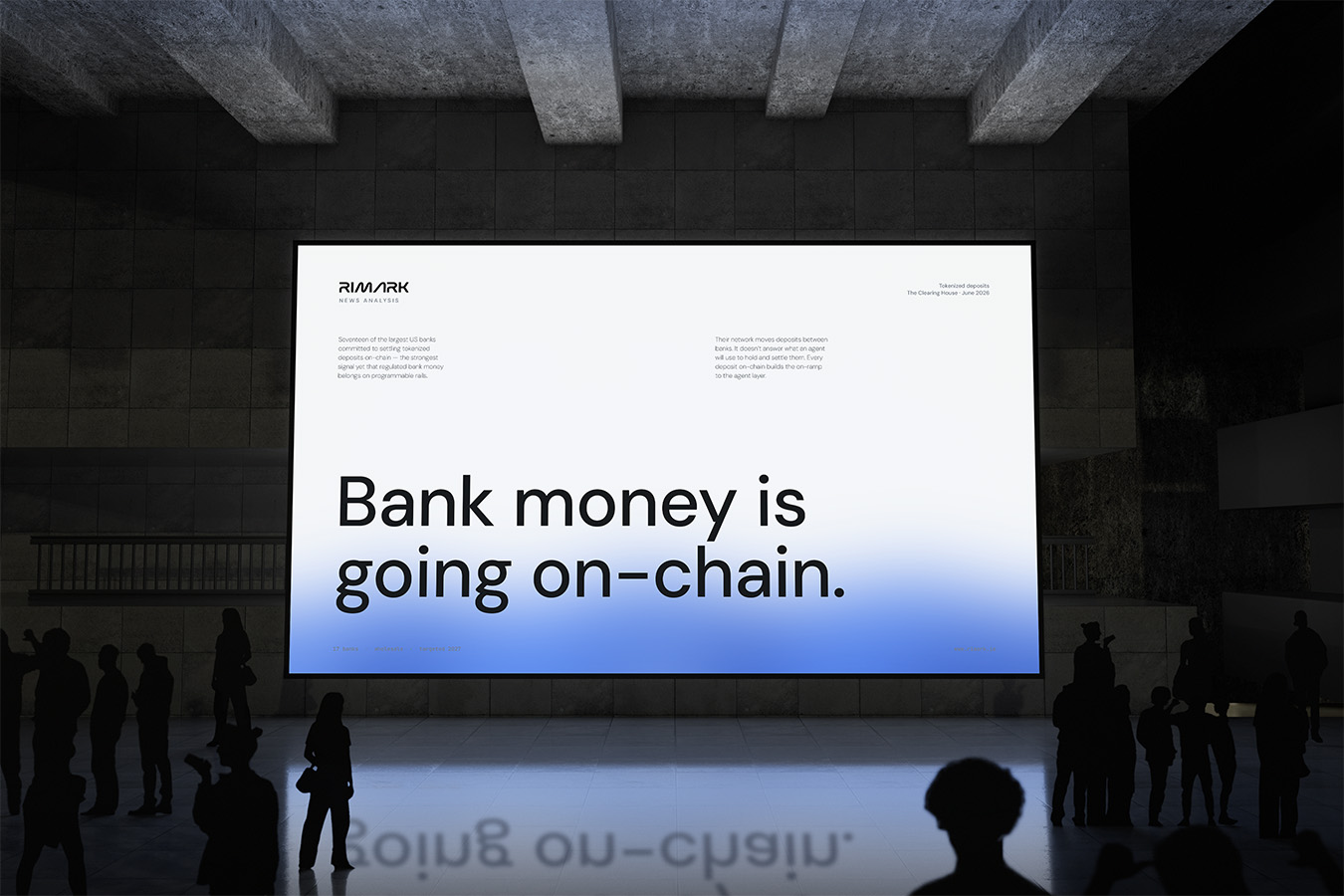
In June 2026, The Clearing House announced a bank-led network to settle tokenized deposits on-chain, backed by a roster of the largest banks in the country. If you're building agentic money, this is the best news you got all year — and not for the reason a competitive reflex might suggest.
Start with what it validates. For years, “put insured bank deposits on a blockchain” was the kind of sentence that got you a skeptical look in a bank boardroom. Now the biggest banks in America have committed to doing exactly that, together, in public. The premise that regulated deposits belong on programmable infrastructure just got endorsed by the institutions with the most to lose from being wrong about it. They spent their own credibility making the core idea mainstream. That's a tailwind you can't buy.
It de-risks the whole category. A community bank evaluating tokenized deposits no longer has to be a pioneer — it can point to the largest banks doing the same thing and ask its vendors why it can't. A regulator looking at on-chain deposits is looking at something the systemically important banks have embraced, not a fringe experiment. Every part of the argument for programmable bank money got easier the day that network was announced.
Now the part that matters for where this goes. The Clearing House's network is built for banks settling with each other. It's a wholesale, institution-to-institution system, aimed at large-corporate treasury, targeted for 2027, and — per the announcement — it hadn't even chosen its underlying technology yet. It is a genuinely important piece of infrastructure. It is also not built for agents.
That's not a criticism; it's a boundary. The network answers “how do big banks move tokenized deposits between themselves.” It doesn't answer “how does an autonomous agent hold a deposit, verify a counterparty, and settle a payment on its own authority at machine speed.” Those are different problems for different users. Interbank settlement between institutions on institutional timelines is one layer. Money that software can hold and spend directly is another, sitting on top.
So the right way to read the announcement is as the market moving in exactly the direction agentic money needs, and stopping precisely where the agent layer begins. The more banks that issue deposits on-chain, the more valuable it becomes to have a settlement layer those deposits can plug into that's built for agents — with the identity, verification, and controls a bank-to-bank wholesale network was never designed to provide, because it was never trying to. Big banks tokenizing deposits doesn't crowd out the agent layer. It builds the on-ramp to it.
This is the difference between a threat and a tailwind. If you thought agentic money meant competing with the banks to move money between banks, the announcement looks like the incumbents arriving first. If you understand agentic money as the layer that lets software use bank deposits — a layer the interbank network doesn't touch — then every bank that puts a deposit on-chain is expanding the ground you're standing on. More on-chain deposits, more institutions comfortable with the model, more regulatory acceptance: all of it is the market building the foundation, and leaving the agent layer for whoever builds it.
The biggest banks just told the market that bank money is going on-chain. They didn't say what agents will use to hold and settle it. That part is still open — and it's the part worth building.