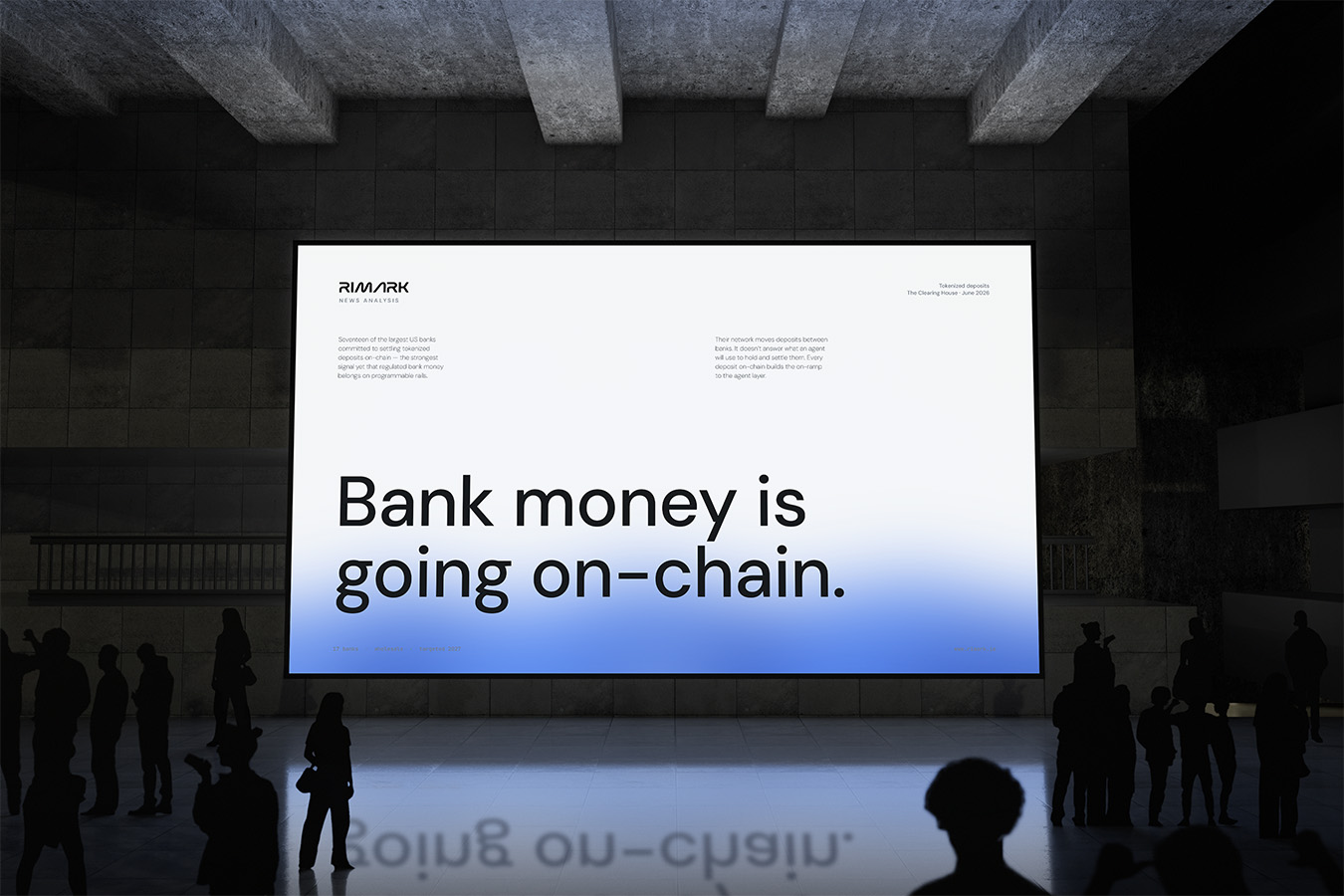
Agentic Money, Defined
The category name for money that AI agents can hold, verify, and settle on their own — without leaving the banking system.

Software got programmable decades ago. So did logistics, communication, and most of the infrastructure the economy runs on. Money didn't. It still moves the way it moved in the 1970s — messages passed between institutions, cleared and settled hours or days later by systems that assume a human is on at least one end.
That was fine while humans were the only ones spending. They aren't anymore.
AI agents now book travel, reconcile invoices, buy compute, and negotiate with other agents. They are becoming economic participants. And when one goes to pay, it hits a wall: there is no money built for it to use. It borrows ours — a card number, a bank login, a person's standing authorization — and hopes the guardrails hold.
Agentic money is the fix. It's the category name for money that an AI agent can hold, verify, and settle natively — without a human in the loop for every transaction, and without leaving the regulated financial system to do it.
That's the whole idea. The rest of this is what it means and why the distinction matters.
Three words, in order: hold, verify, settle
Hold. An agent needs an account it controls, with money in it, scoped to what it's allowed to do. Not a saved card it borrows from a person. Not a prepaid balance someone tops up. Its own funds, with its own limits, spendable against a mandate and no further.
Verify. People run on trust and clean up afterward. You pay, and if something's wrong, you dispute it weeks later. An agent can't work that way at machine speed. It needs to check — cryptographically, before any money moves — that the counterparty is who they claim, the mandate is valid, and the terms are the ones that were agreed. AI doesn't trust. It verifies.
Settle. The money has to move, with finality the agent can rely on, at the speed the interaction happens. Not an authorization that clears overnight. Settlement, on the spot, that both sides can build on.
Hold, verify, settle. Miss any one and it isn't agentic money — it's a person's payment method with a bot pointed at it.
Agentic money is not agentic payments, and not agentic commerce
The terms are getting used interchangeably. They shouldn't be. They're three different layers of the same stack, and only one of them is money.
Agentic commerce is the storefront layer — how an agent finds a product, fills a cart, and checks out. Agentic payments is the authorization layer — how an agent proves it's allowed to pay and passes that permission along. Both are real, and both are being built fast: Google's Agent Payments Protocol, Visa's Trusted Agent Protocol, Mastercard's Agent Pay, Coinbase's x402. More than sixty companies backed AP2 at launch.
Notice what all of that is. It's instructions and permissions — the paperwork of a payment. None of it is the money itself. Every one of those protocols still has to answer the same question at the end: what moves, and where does it settle?
That's the settlement asset. It's the layer nobody has planted a flag on, and it's the layer that decides whether agentic money is trustworthy or just fast.
The settlement asset is the whole argument
You can settle an agent's payment a few ways. You can use a stablecoin — quick, programmable, and already carrying real agent volume today. Or you can use a bank deposit brought on-chain, so it moves like software but stays money.
The difference isn't cosmetic. A stablecoin issued by a non-bank sits outside the insured system; when an agent holds it, the agent holds an IOU from a company. A tokenized deposit stays on the bank's balance sheet. It's the same dollar the customer already had — still insured, still inside the regulated perimeter — that gained the ability to be programmed.
That's the line between agentic money and crypto, and it's a bright one. Agentic money is not a new asset trying to replace the dollar. It's the dollar you already trust, made programmable enough for a machine to use responsibly. The bank keeps the deposit. The customer keeps the insurance. The agent gets money it can hold, verify, and settle.
We think that distinction is the entire game. Fast settlement is easy. Fast settlement that a bank, a regulator, and a customer all trust is the hard part — and it's the only version of agentic money that scales past a demo.
Why this needs a name
Categories get built on purpose or they get built by accident. Payments for the agent economy will be a large category — the projections run into the trillions before the end of the decade — and right now everyone is naming a piece of it: the checkout, the authorization, the wallet, the token.
Agentic money is the name for the money underneath all of it. Deposits an agent can hold under a scoped mandate, verify before it moves them, and settle at the speed its work happens — without leaving the banking system.
That's what we're building at Rimark. Not a blockchain looking for a use, and not a stablecoin competing with the dollar. The settlement layer for money that agents can use, on the same insured deposits banks already hold.
Money was the last thing that wasn't programmable. Agents are the reason it finally has to be.